Press
_____________________________________________________________________________
Blues Music Magazine, Issue 24/January 2020
By Mark Thompson
(click to enlarge)
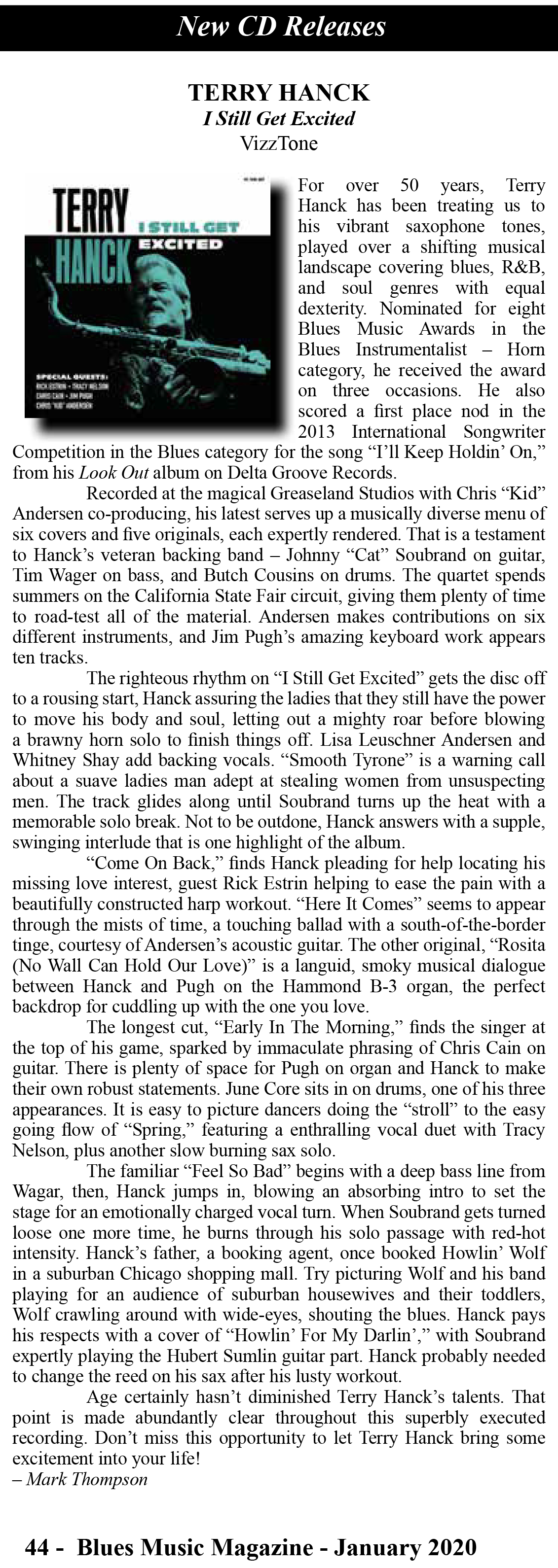
For over 50 years, Terry Hanck has been treating us to his vibrant saxophone tones, played over a shifting musical landscape covering blues, R&B, and soul genres with equal dexterity. Nominated for eight Blues Music Awards in the Blues Instrumentalist – Horn category, he received the award on three occasions. He also scored a first place nod in the 2013 International Songwriter Competition in the Blues category for the song “I’ll Keep Holdin’ On,” from his Look Out album on Delta Groove Records.
Recorded at the magical Greaseland Studios with Chris “Kid” Andersen co-producing, his latest serves up a musically diverse menu of six covers and five originals, each expertly rendered. That is a testament to Hanck’s veteran backing band – Johnny “Cat” Soubrand on guitar, Tim Wager on bass, and Butch Cousins on drums. The quartet spends summers on the California State Fair circuit, giving them plenty of time to road-test all of the material. Andersen makes contributions on six different instruments, and Jim Pugh’s amazing keyboard work appears ten tracks.
The righteous rhythm on “I Still Get Excited” gets the disc off to a rousing start, Hanck assuring the ladies that they still have the power to move his body and soul, letting out a mighty roar before blowing a brawny horn solo to finish things off. Lisa Leuschner Andersen and Whitney Shay add backing vocals. “Smooth Tyrone” is a warning call about a suave ladies man adept at stealing women from unsuspecting men. The track glides along until Soubrand turns up the heat with a memorable solo break. Not to be outdone, Hanck answers with a supple, swinging interlude that is one highlight of the album.
“Come On Back,” finds Hanck pleading for help locating his missing love interest, guest Rick Estrin helping to ease the pain with a beautifully constructed harp workout. “Here It Comes” seems to appear through the mists of time, a touching ballad with a south-of-the-border tinge, courtesy of Andersen’s acoustic guitar. The other original, “Rosita (No Wall Can Hold Our Love)” is a languid, smoky musical dialogue between Hanck and Pugh on the Hammond B-3 organ, the perfect backdrop for cuddling up with the one you love.
The longest cut, “Early In The Morning,” finds the singer at the top of his game, sparked by immaculate phrasing of Chris Cain on guitar. There is plenty of space for Pugh on organ and Hanck to make their own robust statements. June Core sits in on drums, one of his three appearances. It is easy to picture dancers doing the “stroll” to the easy going flow of “Spring,” featuring a enthralling vocal duet with Tracy Nelson, plus another slow burning sax solo.
The familiar “Feel So Bad” begins with a deep bass line from Wagar, then, Hanck jumps in, blowing an absorbing intro to set the stage for an emotionally charged vocal turn. When Soubrand gets turned loose one more time, he burns through his solo passage with red-hot intensity. Hanck’s father, a booking agent, once booked Howlin’ Wolf in a suburban Chicago shopping mall. Try picturing Wolf and his band playing for an audience of suburban housewives and their toddlers, Wolf crawling around with wide-eyes, shouting the blues. Hanck pays his respects with a cover of “Howlin’ For My Darlin’,” with Soubrand expertly playing the Hubert Sumlin guitar part. Hanck probably needed to change the reed on his sax after his lusty workout.
Age certainly hasn’t diminished Terry Hanck’s talents. That point is made abundantly clear throughout this superbly executed recording. Don’t miss this opportunity to let Terry Hanck bring some excitement into your life!
_____________________________________________________________________________
Living Blues Magazine, Issue 263 (October 2019)
By Robert Feuer
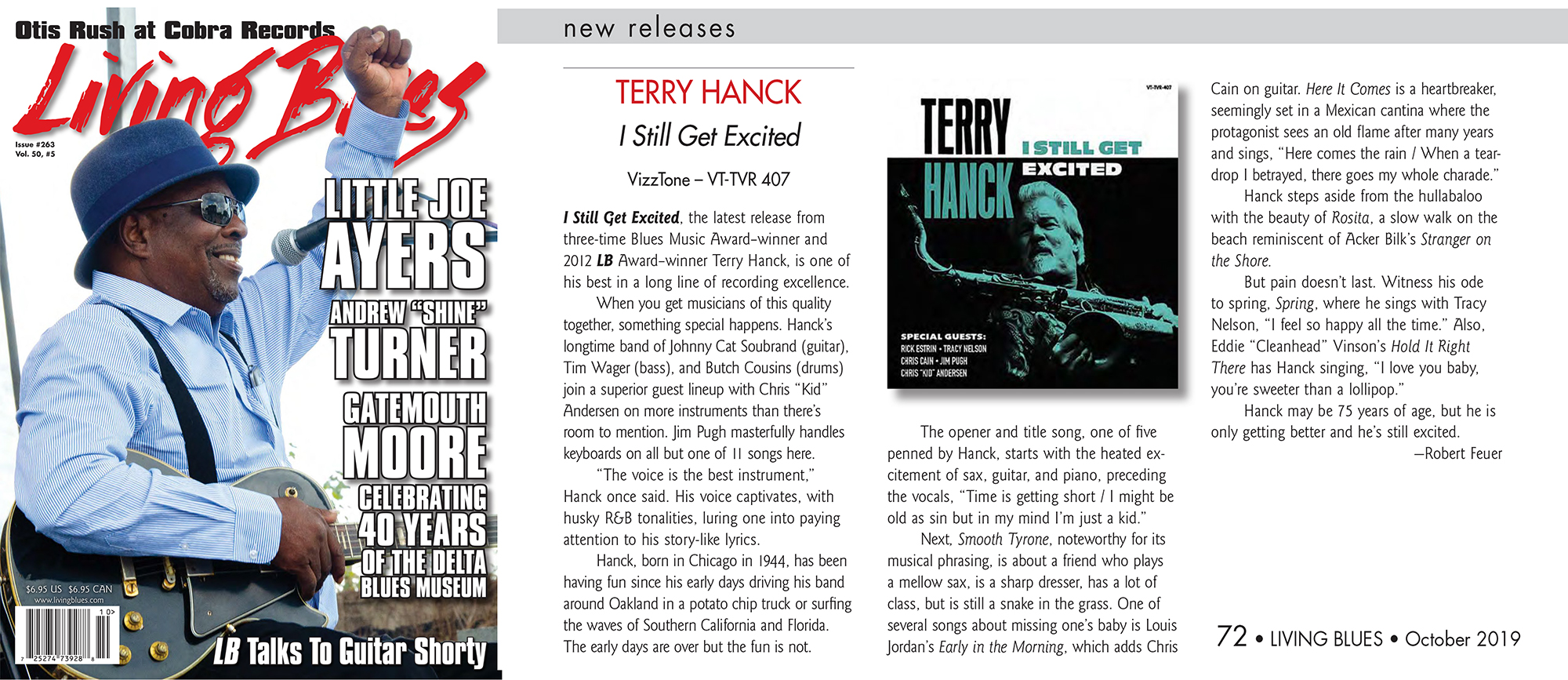
I Still Get Excited, the latest release from three-time Blues Music Award–winner and 2012 LB Award–winner Terry Hanck, is one of his best in a long line of recording excellence.
When you get musicians of this quality together, something special happens. Hanck’s longtime band of Johnny Cat Soubrand (guitar), Tim Wager (bass), and Butch Cousins (drums) join a superior guest lineup with Chris “Kid” Andersen on more instruments than there’s room to mention. Jim Pugh masterfully handles keyboards on all but one of 11 songs here.
“The voice is the best instrument,” Hanck once said. His voice captivates, with husky R&B tonalities, luring one into paying attention to his story-like lyrics.
Hanck, born in Chicago in 1944, has been having fun since his early days driving his band around Oakland in a potato chip truck or surfing the waves of Southern California and Florida. The early days are over but the fun is not.
The opener and title song, one of five penned by Hanck, starts with the heated ex-citement of sax, guitar, and piano, preceding the vocals, “Time is getting short / I might be old as sin but in my mind I’m just a kid.”
Next, Smooth Tyrone, noteworthy for its musical phrasing, is about a friend who plays a mellow sax, is a sharp dresser, has a lot of class, but is still a snake in the grass. One of several songs about missing one’s baby is Louis Jordan’s Early in the Morning, which adds Chris Cain on guitar. Here It Comes is a heartbreaker, seemingly set in a Mexican cantina where the protagonist sees an old flame after many years and sings, “Here comes the rain / When a tear-drop I betrayed, there goes my whole charade.”
Hanck steps aside from the hullabaloo with the beauty of Rosita, a slow walk on the beach reminiscent of Acker Bilk’s Stranger on the Shore.
But pain doesn’t last. Witness his ode to spring, Spring, where he sings with Tracy Nelson, “I feel so happy all the time.” Also, Eddie “Cleanhead” Vinson’s Hold It Right There has Hanck singing, “I love you baby, you’re sweeter than a lollipop.”
Hanck may be 75 years of age, but he is only getting better and he’s still excited.
_____________________________________________________________________________
Living Blues Magazine, Issue 231
By Mark Uricheck
TERRY HANCK AND FRIENDS
Gotta Bring It on Home to You
Ex-Elvin Bishop Band saxophone sideman Terry Hanck for the past quarter century has fronted a jump blues band that rips apart the classic Chicago sound and injects it with a vibrant touch of West Coast sunshine. Hanck’s music is equal parts 1950s speakeasy and skyward- looking faux gospel sincerity, every note played with conviction and ragged sense of faith. Gotta.Bring.It.on.Home features ten tracks, each kicking things up a notch from the previ- ous one, resulting in a houserocker of a record that underscores Hanck’s inimitable live perfor- mances and polished rabble-rousing persona.
Opener Right Now Is the Hour is a track Hanck performed with Elvin Bishop that he says has always stuck with him, complete with soulful Motown-inspired female back- ing vocals and a backbeat that doesn’t quit; Hanck’s wildman sax solo tastefully changes from sensuously buzzing to giddy squeal at will. Pins and Needles contains an almost
Fabulous Thunderbirds–sounding Texas shuffle by way of a dusty Jimmy Rogers bounce. Similarly, the instrumental T’s Groove show- cases Hanck’s knack for rhythmic expression, sounding like Booker T meets T-Bone Walker in a happy modern medium.
My Last Teardrop is somewhat country- leaning fare anchored by a familiar Fats Domino rhythm, Hanck’s upper register vocals crying out, “You take everything from me, and turn my heart to steel.” Guitarist Johnny “Cat” Soubrand sounds particularly vital on this cut, with a pro-vocatively piercing tone and “scraping” rhythm attack that serves the song’s sense of torment. Jam Up, a track originally done by New Orleans bandleader Tommy Ridgley in 1954, really takes the party to the streets late in the set, with a wicked big-band swing and Hanck’s tenor sax commanding the proceedings.
On a record that sounds so live you can practically feel the ground shake, Hanck con- tinues to set the standard for modern blues saxophone thrill.
Vintage Guitar, September 2014
By Dan Forte
Many know saxophonist Terry Hanck from his years with Elvin Bishop. But those fortunate to live in the San Francisco area in the ’70s and ’80s also know Hanck as a great singer and front man, specifically with Grayson Street and the house band at Larry Blake’s (better known as the Rat Band).
Inevitably, this triple- threat (he’s also a fine songwriter) would form his own band. Gotta Bring It On Home To You, his seventh solo CD, carries the postscript "and friends.” One friend is co-producer Chris “Kid” Andersen, known for his work with Charlie Musselwhite and the Nightcats featuring Rick Estrin. Hanck discovered the guitar wiz in Norway and brought him to the States. Here, Andersen shares guitar duties with Hanck’s guitarist of 10 years, Johnny “Cat” Soubrand, along with cameos from Debbie Davies and Bob Welsh. Cat’s exaggerated vibrato on “Peace Of Mind” recalls Magic Sam.
Hanck has a big tenor tone like greats ranging from Joe Houston to Junior Walker, sometimes shooting into its upper register with ease before reaching still higher. He specializes in old-school R&B, soul ballads, jumpin’ blues, and, to quote one of his originals, “good, good rockin’.”
_____________________________________________________________________________
Elmore Magazine, July/August 2014
If you don’t know Terry Hanck, you are missing some exciting, tenor sax-driven blues and soul. This Chicago native, now based in South Florida, is steeped in those genre’s traditions as a musician, singer and songwriter (he wrote or co-wrote five of the ten songs here).
Hanck’s choice of material and his presentation are impeccable. He starts this album with Elvin Bishop’s “Right Now is the Hour,” which Hanck learned from Bishop himself (they play together occasionally), and he does it proud. The slow burn of “T’s Groove” is hot enough to cook a thick steak on. Vocally, Hanck drips 1950s soul on the first half of “My Last Teardrop,” then punches it into overdrive.
Secure in his own playing, Hanck lets his band and friends (including Debbie Davies, Kid Andersen and Doug James) step to the forefront and take leads. If soul/blues is your bag, grab this.
Chico News & Review, June 5, 2014
By MIles Jordan
Saxman/bluesman/soulster Terry Hanck has bolstered his long-time quartet—guitarist Johnny “Cat” Soubrand, bassist Tim Wagar and drummer Butch Cousins—with a handful or two of friends who help out here on piano, guitar, organ and backup vocals. Chief among them is co-producer Chris “Kid” Andersen, the guitarist Hanck discovered in Norway a decade or so ago. Hanck’s nitty-gritty vocals and impassioned saxophone playing are the real reasons to celebrate his performances—both in person and on disc—and he doesn’t disappoint here. His songwriting skills are first-rate, too, as evidenced by “Peace of Mind,” a slow blues on which he offers up this advice: “If you’ve got a good woman, better hold on tight/ give her what she needs, every day and every night.” Among the highlights are the title track, with Debbie Davies guesting on guitar and vocals; “One Horse Town” (with both Soubrand and Hanck wailing); Hanck’s soulful playing on every tune—especially on “Whole Lotta Lovin’” (Soubrand’s no slouch here either); and Andersen’s guitar work on the instrumental, “T’s Groove.” Another nice addition is baritone saxman Doug James on the up-tempo instrumental “Jam Up.” Hanck, et al. slow things down on his soul-drenched “My Last Teardrop” but then exorcise his misery by pepping things up half-way through.
_____________________________________________________________________________
Blues Revue, November 2011
By Thomas Cullen III
Slick back your hair, put on your shades and start the Fifties party with TERRY HANCK'S riotous record.
In the grand tradition of R&B tenor sax master blasters like Red Prysock, Big Jay McNeeley, and Junior Walker comes journeyman honker Terry Hanck with a boisterous blend of blues, R&B, and soul that defines his 40 year career, music he aptly calls "Greasy Soul Rockin' Blues."
Hanck, a Chicago native, relocated to California in 1967 when he was 23, and has worked with the late Luther tucker, and most notably, Elvin Bishop. Hes been blowing up a storm on his own since 1987 and is a confident, soulful vocalist who is equally adept of going deep on a slow blues with the drag-n-grind "You Coulda Let Me Go, " and a cathartic Southern soul ballad suggestive of James Carr, " Appreciate What You Got ( two of five solid originals); he can also jump for joy with authority as he demonstrates in Louis Jordan's "Just Like A Woman" and Tiny Bradshaw's "Train Kept A Rollin." The other R&B chestnuts come from Chuck Willis, Billy Wright, Fats Domino, The Five Royales and Freddie King.
My favorite track, "You Give Me Nothing But the Blues , " was penned by Maggie Longmire of the Lonesome Coyotes--kudos to Hanck for finding it. The album's funkiest tune is a rump-wrigglin' amalgam of Junior Walker's "Shotgun" and Lowell Fulson's "Tramp, " replete with Walker's signature bleats, squeals, and squalls, and an elongated solo from Hanck that I didn't want to end. Co-produced by the wizardly Kid Andersen (who contributes guitar on six cuts) and recorded at his Greaseland Studios in San Jose, Hanck is superbly backed by guitarist Johnny "Cat" Soubrand, bassist Tim Wagar, drummer Butch Cousins, and keyboardist Bob Welsh. There aren't many saxophonist leading blues bands these days or recording robustious, lifetime in the making albums like " LOOK OUT! HIGHLY RECOMMENDED.
______________________________________________________________________________
bluesinthenorthwest.com, 10.24.11
LOOK OUT!, Terry Hanck (Delta Groove Music)
By Grahame Rhodes
This cd has been patiently waiting for a review for a good while now . . . and what a treat it is, perfectly summed up by the description on the cover . . . 'Greasy Soul Rockin' Blues" . . . a hugely enjoyable collection from the Chicago-born, West Coast-based tenor saxophone player, singer and bandleader Terry Hanck, and his very fine collection of musicians.
The album was co-produced by Hanck himself and ace Norwegian guitarist Chris 'Kid' Andersen, who way back in 2000 actually relocated from his native country to the USA for a four-year stint in Hanck's band . . . he looms large here with the project recorded at his Greaseland studio, and apart from the afore-mentioned co-production he also recorded and engineered and of course lends his excellent and distinctive guitar work to some six tracks, also chipping in with bass, piano and organ!
Hanck himself brings decades on the road to the plate here, a fine player and singer who has picked some great covers to accompany his orginal tunes. The rest of the band features the also superb guitar of Johnny 'Cat' Soubrand, with bass duties shared between Tim Wagar and guest Lorenzo Farrel, and Butch Cousins on drums - the younger brother of bass player Richard Cousins, who has been associated with Robert Cray for many years. Keyboard player Bob Welsh is also present on piano and Hammond B3 organ.
Apparently Hanck said he went for a 'live' sound on a lot of the tracks, and the album certainly has that feel and energy to it . . . kicking off with his own new "Here It Comes", sounding like an old rhythm and blues tune but with funky feel and nice background vocals from Lisa Andersen and a snarling, biting solo from Kid Andersen. Chuck Willis's "Keep A Drivin'" has a nice laid-back swing to it, with some sharp saxophone playing from Terry Hanck. The old tune "Ain't That Just Like A Woman" is a joy and swings like crazy, driven by Hanck's sax and some delightful guitar from Johnny Cat . . . who definitely comes from that Junior Watson and Alex Schultz school of guitar players.
The seven minutes of "You Could Have Let Me Go" is an old Hanck song that is updated here, a slow blues with more ace guitar from Johnny Cat, who also stars on a sparkling take on Freddie King's "Side Tracked", with Bob Welsh's fine Hammond B3 organ and crisp solo from Hanck. The shuffle "Appreciate What You Got" is a new original and a wry look at the current state of the USA economy, with Kid Andersen cooking up some guitar fireworks on this one.
The often-covered Tiny Bradshaw tune "Train Kept A Rollin'" is another gem, with the whole band sounding as if the are having a ball! Hanck has also delved back to bring his "I Keep On Holding On" to this album, a lovely soulful tune with sweet vocal and a fine band performance with more top work from Bob Welsh. "You Give Me Nothing But The Blues" is another great cover with length sax intro from Hanck, the driving, funky blues also sees Johnny Cat deliver a superb lengthy guitar solo.
As ever with a Delta Groove recording the whole things sounds just marvellous . . . and at 66 it sounds like Terry Hanck is having a ball to go with some well overdue recognition, well done to all, a most enjoyable release and highly recommended.
______________________________________________________________________________
2011 Reviewers Rave on Terry Hanck's LOOK OUT! (Delta Groove Music)

"Drop dead knocked my socks off!!!! You definitely have a winner here!"
- Peggy Nagel, KAFM, Grand Junction, CO
"Good, greasy, killer tunes..."
- Marty Kool, KXCI, Tucson, AZ
" Hanck wails like a big dog on sax and vocals..."
-Paul Libertore, Marin Independent-Journal
"From the raunchy licks of Chuck Willis' soulful lament, "Keep A Drivin'" to the joyous shouts of "Ain't That Just Like a Woman" to the slinky and sensuous R&B original "You Coulda Let Me Go" to Fats Domino's rollicking "Hello Josephine" to Ike Turner's fiercely upbeat "Just One More Time," the 66-year-old Hanck whispers, soars and honks his way through music that's filled with joy and soul, and that's more than you can say about most music available on the airwaves these days. "
-Jim White, Pittsburgh Post-Gazette
**** -4 Stars/Excellent -- "Oh my goodness! Just a little past half way through 2011 and we have the lead contender for album of the year. From Hanck's love for vintage blues and R&B, evident on almost every track, to his superb and serious saxophone chops, to his crack band and his song selection, there's not a track of filler on the album. But there is something intrinsically fresh to his sound as well. For a 66-year old cat, he sure plays like an unbridled and fearless youth...His fiery reed work, beautiful tone and effortless, inventive melodies make for a thoroughly enjoyable 62-minutes of listening.
Hanck's voice is a marvel. He can make it growl, ache, croon, moan and tease, and then some. It is a superb instrument in its own right. Listen to "I Keep Holding On" and tell me I'm wrong. I also can't say enough about the emergence of Johnny "Cat" Soubrand as a lead guitarist of originality, fire and consummate grace. He proves here he is among the emerging great ones."
-James Jordan, Golden Gate Blues News
" It turns out Hanck is not only a gifted tenor saxophonist; he can sing and write songs as well. His singing is controlled, rhythmically diverse. He emphasizes certain words and emotions, pulls back on others, subtle use of melisma. With a rock solid band behind him - guitarist Johnny "Cat" Soubrand, new bassist Tim Wagar, and drummer Butch Cousins - Hanck can tear it up in a wide variety of blues and R&B styles."
-Steve Pick, About.com/Blues
"Terry is the coolest cat in the room. This new one, his first major label release (Delta Groove Music), is the best CD I have heard all year ... If there is justice in the music world, Terry will finally hit it big."
-Scott " Hambone" Hammer, Chicago Blues Guide
"This is the kind of stuff that the King Record label was built on - the kind of records you used to hear all day long in the 1950s to early 1960s.Hanck infuses in every performance on the album with verve and zeal ....it is easy to see why I include Look Out! among the handful of exceptional recordings I have heard so far this year.
-Mark Thompson, Blues Blast Magazine
Hanck is a full-bodied saxophonist and sensationally soulful singer. In addition to a handful of his own songs--the slow, soulful and rueful "You Coulda Let Me Go" ("But instead you started a flame") and the topical "Appreciate What You Got" (he's got a stack of bills, a bad hip, etc.)--the band pep things up considerably with Tiny Bradshaw's "The Train Kept a Rollin'" and a powerhouse version of Louis Jordan's "Ain't That Just Like a Woman."
-Miles Jordan , Chico New & Review
" Terry Hanck is a party on a platter."
-Music City Blues News (Nashville)
"This album is a great find and a scorching summer listen. " 5 Stars
-Dana Wright, Muzikreviews.com
______________________________________________________________________________
Blues Blast Magazine, 07.28.11
By Mark Thompson
The cover of this disc states "Greasy Soul Rockin' Blues" and for once, there is truth in the advertising.
This is the kind of stuff that the King Record label was built on - the kind of records you used to hear all day long in the 1950's to early 1960's. It's not surprising that Terry Hanck grew up listening to the hot R&B and blues songs of the time. What is surprising is that the the 66 year-old Hanck is playing and singing with energy level of musicians several decades younger. His brawny tenor sax calls out like a voice in the wilderness, one minute soothing your soul and the next beckoning you to the dance floor. Equally impressive is his singing throughout the disc. Hanck manages to change his tone enough on several tracks that you might think someone else is handling the lead vocal. What is consistent is verve and zeal that Hanck infuses in every performance on the album.
Hanck spent ten years as a member of the Elvin Bishop Band before deciding to head off on his own. At one point, he befriended an aspiring guitarist during a tour stop in Oslo, Norway. Chris "Kid" Andersen later made the trip to California and was a member of Hanck's band for four years. After that, he did a stint with Charlie Musselwhite before accepting his current position with Rick Estrin & the Nightcats. Besides playing guitar on six songs, Andersen engineered the sessions, co-produced the recording with Hanck a and plays keyboards on two cuts. The rest of the band includes Johnny "Cat" Soubrand on guitar, Tim Wager on electric bass, Butch Cousins on drums, Bob Welsh on piano & Hammond B-3 and Lorenzo Farrel on upright or electric bass on three tracks and B3 organ on two others.
Hanck's musical preferences are readily apparent in the songs he selected to cover. "My Girl Josephine" has the easy-rolling tempo of New Orleans R&B, providing plenty of room for strong solos from Soubrand and Hanck. The band takes "Train Kept A Rollin'" back to its jump blues origins as the leader blows one exciting chorus after another over the hand-clapping rhythm. Freddie King's instrumental "Side Tracked" is another delight as Hanck's solo builds to a climax in the upper register of his horn before Soubrand's solo will leave you wondering where this talented guitarist has been hiding out. Hanck's muscular blowing and dynamic singing spark Chuck Willis' "Keep A Driving". There are more guitar and sax fireworks on "Ain't That Just Like a Woman" before the tempo slows down for "Catch That Teardrop", an R&B tearjerker with Andersen's guitar adding some heat. "You Give Me Nothing But the Blues" was popularized by Louisiana bluesman Guitar Slim but Hanck and the band turn it into a show stopping tribute to Jr. Walker and the All Stars. Soubrand's stinging guitar licks set the stage for Hanck, who blows the house down!
The disc features five of Hanck's compositions that match the quality of the rest of the material. "Appreciate What You Got" finds Hanck doing a humorous assessment of the current state of affairs and trying to stay positive. Another gem is "I Keep On Holding On", with Hanck pouring his heart out to the woman he loves, refusing to give up on his dream. The arrangement of "Here It Comes" is dominated by Welsh on organ. "Girl, Girl, Girl" has a bouncy, reggae-influenced rhythm plus another strong vocal from the leader. Farrel's plucks some fat notes from his upright bass behind Hanck's late-night, smoky sax solo to open "You Coulda Let Me Go", a slow blues with another fine vocal from Hanck. Soubrand rips it up on the closing number, paying tribute to Ike Turner's guitar style on "Just One More Time", but not before Hanck makes a statement of his own on the sax.
This one is a party from start to finish. The joy and passion that Hanck brings to this project will win you over. When you add in the outstanding contributions of his band and guest musicians, it is easy to see why I include Look Out among the handful of exceptional recordings I have heard so far this year. It may be old school but it sure sounds good !!!!
Reviewer Mark Thompson is president of the Crossroads Blues Society in Rockford. IL. He has been listening to music of all kinds for fifty years. The first concert he attended was in Chicago with The Mothers of Invention and Cream. Life has never been the same.
Chicago Blues Guide , July 2011
By Scott "Hambone" Hammer
Saxman and vocalist Terry Hanck was born in Chicago and first made a name for himself playing with Elvin Bishop in the 1970s.
He can be heard blowing sax on Bishop's big hit "Fooled Around and Fell in Love." He currently lives on the West Coast and often gigs in Florida, too. I saw him perform at The Back Room in Boca Raton a few years back and he blew me away. Terry is the coolest cat in the room. He has put out a number of excellent self-produced CDs over the last few years. This new one, his first major label release, is the best CD I have heard all year. The record cover says "Greasy Soul Rockin' Blues" and that sums up how Terry plays. He is a fine vocalist and demonstrates his skills on some slow ballads. Guitarist "Kid" Andersen played on and produced this CD, which contains some nice originals and obscure covers. If there is justice in the music world, Terry will finally hit it big.
http://www.chicagobluesguide.com/hambone/hambone-april/hambone-current.html
About.com Blues, July 2011
By Steve Pick
If you happened to catch blues rocker Elvin Bishop in concert any time between 1977 and 1987, the odds are you were struck by the particularly skillful and powerfully evocative saxophone player in his touring band. That was Terry Hanck, who then left Bishop to run his own band. The crowds may be smaller, the record sales may be less, but the music just might be even better.
Terry Hanck's Look Out!
It turns out Hanck is not only a gifted tenor saxophonist; he can sing and write songs as well. His singing is controlled, rhythmically diverse. He emphasizes certain words and emotions, pulls back on others, subtle use of melisma. With a rock solid band behind him - guitarist Johnny "Cat" Soubrand, new bassist Tim Wagar, and drummer Butch Cousins - Hanck can tear it up in a wide variety of blues and R&B styles. The live band is augmented on this new album with keyboardist Bob Welsh and co-producer/guitarist Chris "Kid" Anderson (Anderson, who played with Hanck for years, is currently the hot-shot string bender for Rick Estrin and the Nightcats).
Hanck contributes five original songs to Look Out!, four of which are exceptionally good. Album opener "Here It Comes" sounds like a lost classic R&B number from the late 1950s, a danceable, infectious groove with an unforgettable hook and a bit of a Latin groove added for spice. Anderson contributes a twangy and particularly exciting short guitar solo, supporting Hanck's lyrics about the return of a long-forgotten love. "You Could Have Let Me Go" is a song Hanck obviously loves - this is at least the third time he's recorded and released it. It's no wonder he keeps turning to this slow, sultry, jazzy blues number. It's a perfect showcase for his big, fat tenor sax, and his equally huge vocal chops. And the concluding verse is a corker: "You know that you're dirty and you're lowdown and you take a man down just because you can/That just makes me love you more baby, that's what makes the world so sad."
Catch That Teardrop
"I Keep On Holding On" was the title track of his 2002 album, but there's nothing wrong with a new version of a song this dramatic, especially since it gives him a chance to show off his ability to vocally hold a single note at full power. Guess that's a quality gained from playing the sax. "Appreciate What You Got" is a brand new gem which in places is reminiscent of some of the creative methods of Lyle Lovett in the way Hanck flows complicated metrics across the bar lines in order to deliver all the words. It's a bitterly sarcastic blast at the mess the world is in, ending up with the only solace he can find: "I don't want to be ungrateful but if I may be so bold, the way mankind is headed, I'm glad I'm old." As for "Girl Girl Girl," the less said the better. Looking for variety is all well and good, but a lite reggae song smack dab in the middle of a record is never called for.
For the most part, Hanck makes some delightful choices of cover material. "Catch That Teardrop," originally done by the "5" Royales, may be in for a major revival. The Bo-Keys, the spectacular group of Memphis soulsters old and young, do a version (though they call theirs "Catch This Teardrop") on their new album, Got to Get Back! It couldn't happen to a more deserving obscurity; it possesses one of the most infectiously simple hooks of any R&B song of its era. Hanck also tears it up on "Just One More Time," a masterful song Ike Turner wrote for the wonderful yet sadly barely known Billy Gayles. Hanck masters the phrasing of the original, and Kid Anderson nails the stinging guitar approach Turner did so well. Anything that calls attention to Turner's Kings of Rhythm recordings is a good thing; those records deserve to be in every home.
Ain't That Just Like A Woman
Nice takes on Chuck Willis' "Keep a Drivin'" and Fats Domino's "My Girl Josephine" are also standouts. The former features some of Hanck's most passionate singing and blowing; it sounds like rock'n'roll still capable of scaring parents after all these years. The latter gives Cousins a chance to emulate his favorite drummer, the late great Earl Palmer. Hanck also does a terrific job on "Train Kept A Rollin'," skipping past the Yardbirds and Rock'n'Roll Trio templates to revisit the jump-blues stylings of the Tiny Bradshaw original. A Freddie King instrumental, "You Coulda Let Me Go," allows Soubrand to show off his chops with a fiery and intense take on the master's guitar stylings.
The decision to cover the Louis Jordan song "Ain't That Just Like a Woman" gives the band a chance to show off its ability to stomp like the master himself. Soubrand's propulsive guitar soloing is well worth hearing, and Hanck has a blast with his sax solo, building off the melody and rising to a squealing finish of pure delight. But, let's face it, the lyrics are rather dated and the sentiments offensive. A song this blatantly sexist should be retired, especially since there are plenty of other Louis Jordan classics which could be substituted.
Steve's Bottom Line
So, one musical and one lyrical misstep aside, that leaves eleven songs more than entertaining enough to make Look Out! one of the better blues albums of the year so far. The front cover declares this to be a record with "greasy soul, rockin' blues," and it does not disappoint. Beyond the obviously intoxicating pleasures of those terms, Hanck never forgets to bring deeper nuance to his delivery of originals and covers. Look Out! delivers all the goods. (Delta Groove Records, released June 21, 2011)
Golden Gate Blues Society Newsletter, July 2011
By Joseph Jordan
Four stars - Excellent
Terry Hanck
"Look Out!"
Oh my goodness! Just a little past half way through 2011 and we have the lead contender for album of the year. Terry Hanck has put his very best on this recording, and that's saying a lot.
From Hanck's love for vintage blues and R&B, evident on almost every track, to his superb and serious saxophone chops, to his crack band and his song selection, there's not a track of filler on the album. But there is something intrinsically fresh to his sound as well. For a 66-year old cat, he sure plays like an unbridled and fearless youth.
Hanck's tenor, as usual gets a whole lot of airtime on this one, just listen to "Keep A Drivin'" or "Ain't That Just Like a Woman" or, pretty much any track on the CD. His fiery reed work, beautiful tone and effortless, inventive melodies make for a thoroughly enjoyable 62-minutes of listening. (He's Elvin Bishop's favorite sax player too!)
"Girl, Girl, Girl features a reggae groove (with great drumming by Dennis Dove) and the oft-recorded "Train Kept a Rollin'" provides a swingin' alternative to the rock and roll versions you may be familiar with.
Hanck's voice is a marvel. He can make it growl, ache, croon, moan and tease, and then some. It is a superb instrument in its own right. Listen to "I Keep Holding On" and tell me I'm wrong.
I also can't say enough about the emergence of Johnny "Cat" Soubrand as a lead guitarist of originality, fire and consummate grace. He proves here he is among the emerging great ones. With phrasing, tone and string-bending to burn, his contributions alone are well worth hearing. Check out, "You Coulda Let Me Go" or his take on the Freddie King/Sonny Thompson instrumental, "Side Tracked."
The genius of Chris "Kid" Anderson who co-produced the sessions (along with Hanck.) is astounding. He recorded, engineered and mastered the album beautifully. As a former member of Terry's band, he has an instinctive feel for what works and how not to push the band into anything less than their utmost. He even contributes a wonderful (and playful) guitar solo on Hanck's original "Appreciate What You Got." Add to that his all-over-the-place contributions on rhythm guitar, keys, bass and vocals and you've got a consummate musician.
Hanck wrote or co-wrote five of the 13-cuts on the CD, and they show his musicianship isn't limited to stage-presence and playing alone. His crack band of drummer Butch Cousins, bassist Tim Wagar hold down the rhythm with finesse and provide a free-and-easy background bottom for the stars to shine. The ever-great Bob Welsh on keyboards just smokes, and Lorenzo Farrel on bass and organ is a fine addition to the mix.
This is a multiple-listening CD; a turn-it-up in your car CD; a have-a-party CD and just about anything else you can think of. If you've not hipped yourself to Terry Hanck and his band, this is an superb place to start.
Pittsburgh Post-Gazette , 06.29.11
LOOK OUT!, Terry Hanck (Delta Groove Music)
By Jim White
Today we have another CD from someone you may not know, but you should -- Terry Hanck has been adding his blues and soulful saxy ways to music since the early 1970s, most notably for a time with Elvin Bishop, where he added his chops to Bishop's hit "Fooled Around and Fell in Love," among others. Hanck's raunchy sax also graced bands from Charlie Musselwhite to Little Charlies Baty and later Rick Estrin and the Nightcats.
I'm sure you all of know that tough, sexy sax takes blues and soul, and especially great old rock 'n' roll, to sublime levels. That's exactly what Hanck does in his new CD, "Look Out" (Delta Groove Music).
With guitarists Chris "The Kid" Andersen and Johhny "Cat" Soubrand adding sharp licks, Hanck runs through a set that includes his own vocals in a set of covers and originals that test the limits of endurance for humans to celebrate the saxophone.
From the raunchy licks of Chuck Willis' soulful lament, "Keep A Drivin'" to the joyous shouts of "Ain't That Just Like a Woman" to the slinky and sensuous R&B original "You Coulda Let Me Go" to Fats Domino's rollicking "Hello Josephine" to Ike Turner's fiercely upbeat "Just One More Time," the 66-year-old Hanck whispers, soars and honks his way through music that's filled with joy and soul, and that's more than you can say about most music available on the airwaves these days.
Hanck may never hit Moondog's, but if you pick up on this CD, you'll hear some music that will satisfy your soul. Put some more sax in your life -- you won't be sorry.
http://communityvoices.sites.post-gazette.com/index.php/arts-entertainment-living/blue-notes/29257-not-enough-sax-in-your-life-try-terry-hanck
Muzik Reviews.com, 06.23.11
LOOK OUT!, Terry Hanck (Delta Groove Music)
By Dana Wright
Terry Hanck, saxophonist, bandleader, singer and songwriter is one of the most influential and formidable voices in blues and soul today. Look Out! is his sixth album. His band is comprised of Johnny Cat Soubrand (guitar), Butch Cousins (drums) and Tim Wagner (bass).
"Train Kept A Rollin" has a feel of New Orleans rock and soul, with a bit of swing to sweeten the mix. This song is a crowd favorite already, and I can see why. It has groove. Hanck nails the sax right on the head and Soubrand wails on the guitar. Every element of the track is the purest form of blues and soul. Hanck's vocal performance is smooth and had my attention on the first spin of the song.
"Appreciate What You Got" is an original song by Hanck. It is very appropriate for the economic times we are living in. The lyrics have humor, but also remind us to "appreciate what you got." This is one of my favorites on the album. The sax and guitar are hot!
"My Girl Josephine" is another favorite. The guitar and bass really make this song come alive. It is a vibrant wave of sound from beginning to end. A man is thinking about a girl he used to know. She thought he was poor, but he went out of his way to help her. She used to laugh at him. Now he wonders if she remembers him like he remembers her. The beat is wild with swing and captures a memory in colorful detail.
"Just One More Time" is a blend of West Coast jump, a feel of 50's rock, and soul. The character in the song is missing a girl, and the lyrics are full of the blues which are belted out in clear, crisp form. The song spins up and carries you on a journey of musical bliss.
Every song on Look Out! is an audible masterpiece. West Coast jump, blues, rock and a whole lot of soul are infused into every note. Hanck and his band are poetry in motion with jazz on the wing. Five original songs grace the album, but my favorite is "Appreciate What You Got." Old favorites also make a showing. This album is a great find and a scorching summer listen.
5 stars
http://www.muzikreviews.com/reviews.php?ID=1675
Always, Terry Hanck (Vizztone)
By Miles Jordan
Tenor saxophonist Terry Hanck--a regular visitor to Chico back in the '80s and '90s with his band, the Soul Rockers--is also a powerful singer/songwriter. For this, his fifth CD, he's written all the songs and demonstrates his unique ability to fuse its various elements--soul, blues, ballads and boogaloo--into a cohesive whole. As one of Elvin Bishop's main men back in the '70s, he's coaxed his ex-boss into joining him on two tracks: the bouncy "Cupid Must Be Stupid" ("to think I'm gonna stay here with you") and "Peace of Mind," a relaxed bit of blues about a guy who's finally settled down and is "so glad to have found some peace of mind." An astute musician, Hanck has always surrounded himself with terrific sidemen; here he's got guitarist Johnny "Cat" Soubrand and drummer Butch Cousins, with Chris "Kid" Andersen on bass and rhythm guitar. Andersen (ex-Hanck and -Musselwhite) is a much-in-demand guitarist and shows why a few times here. But the focus is on Hanck, and in this guitar-centric era, it's especially welcome to have the booting sax work of a guy like this at the helm of his own band; one listen to his achingly beautiful playing on the title track should be all it takes to convince you.
http://www.newsreview.com/chico/content?oid=888758
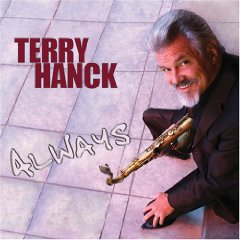 |
TERRY HANCK ALWAYS TVR 405 VIZZTONE REORDS |
In the mighty mighty tradition of "Night Train," "Shotgun," and "Quarter To Three," master saxman Terry Hanck has released "Always" on the Vizztone label. This set rocks from start to finish, and hearkens back to a time when guys like Jr. Walker and Gene "Daddy G" Barge ruled the airwaves. Terry has been around the contemporary scene for quite some time, having toure d with Elvin Bishop for a number of years, and having released four CD's prior to this one. His style encompasses everything from the retro-rock of the Fifties to the Maceo Parker-influenced funk of the Seventies. This also is Terry's first CD of all original material. Check out the cool instrumentals "Always" and "Stingy" to get a good idea where Terry's roots lie. There is quite a cast of backing musicians, too. Johnny Soubrand and Kid Anderson work the guitars, Michael Brooks is on bass, and Butch Cousins is on drums. There are some cool special guests, too. Old friend Elvin Bishop drops in on guitar, as well as Los Lobos' Steve Berlin on sax, Jimmy Pugh on B-3, and Tracy Nelson and Vickie Carrico on backing vocals. Terry's no slouch in the vocal area, either. Honed from years of blowing that sax, he has quite a powerful delivery and range. He has a lot of fun with all these cuts, too. A man that's had enough of bad love says that "Cupid Must Be Stupid to think I'm gonna stay with you!" And, on a softer note, "I've cried My Last Teardrop" is a good 'un for the slow-dancers. "The First Time Around" and "Good Kind Of Lovin'" evoke the classic soul era. And, the swingin' "Deep Fried Twinkies" has a groovy New Orleans-like vibe goin on. We had two favorites, too. Terry swears he's gonna bust outta his slump, get some real cash money, and promises things are gonna get better in the rowdy "When I Get My Shit Together!" There's some good blues-rock represented in "Good Good Rockin' Goin' On," with Terry's high-end notes wailin' away at the bridge! Terry Hanck and "Always" is a party on a platter, folks. Just roll back the rug and commence to gittin' down, because this one is a guaranteed table-thumpin' smash! Until next time....Sheryl and Don Crow, Music City Blues News |
|
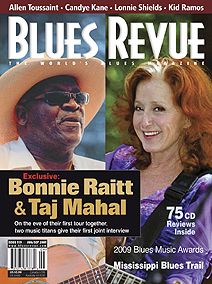 |
Blues Revue Magazine loves Terry Hanck! Here is the review in the current issue (Bonnie Raitt/Taj Mahal cover) (August/September 2009) "Tenor sax player Terry Hanck sings like he blows — sweetly, with a touch of grit — and shares solo space with his excellent guitarists, Johnny Soubrand and Kid Andersen. Jimmy Pugh and Bob Welsh on keyboards fill out the sound. Updating the spirit of the Fifties and Sixties, Always (TVR Music/VizzTone) is a ton of fun. It explores Farfisa-toned funk, mellow-toned ballads, Doc Pomus-inspired R&B, a Stonesy rocker, and plenty of blues. Prime cuts: “Good Good Rockin’ Goin’ On” unabashedly tips its hat to Junior Walker; “Good Kind of Lovin’” is snare-popping soul; and “When I Get My Shit Together” is a classic down-and-outer’s boast. Hanck’s former boss, Elvin Bishop, plays guitar on two tracks." -- Tom Hyslop, Blues Revue |
Chico News & Review (December 18, 2008)
Tenor saxophonist Terry Hanck—a regular visitor to Chico back in the ’80s and ’90s with his band, the Soul Rockers—is also a powerful singer/songwriter. For this, his fifth CD, he’s written all the songs and demonstrates his unique ability to fuse its various elements—soul, blues, ballads and boogaloo—into a cohesive whole. As one of Elvin Bishop’s main men back in the ’70s, he’s coaxed his ex-boss into joining him on two tracks: the bouncy “Cupid Must Be Stupid” (“to think I’m gonna stay here with you”) and “Peace of Mind,” a relaxed bit of blues about a guy who’s finally settled down and is “so glad to have found some peace of mind.” An astute musician, Hanck has always surrounded himself with terrific sidemen; here he’s got guitarist Johnny “Cat” Soubrand and drummer Butch Cousins, with Chris “Kid” Andersen on bass and rhythm guitar. Andersen (ex-Hanck and -Musselwhite) is a much-in-demand guitarist and shows why a few times here. But the focus is on Hanck, and in this guitar-centric era, it’s especially welcome to have the booting sax work of a guy like this at the helm of his own band; one listen to his achingly beautiful playing on the title track should be all it takes to convince you.
--Miles Jordan
online version here
San Luis Obispo Blues Society News (December 2008)
"Terry Hanck’s Always is the newest release from the premier saxophone player in the blues today. Since his start with the
Elvin Bishop Band, Terry has been on the road for the last thirty years entertaining audiences with his energetic R&B saxophone style and cool vocals. Although this CD contains all original material, the sound is familiar because it is based on retro blues styles from the early 1950s to the 1970s. The music is highly influenced by Chris “Kid” Andersen who plays guitar and bass on several songs and co-produced the CD with Terry. Other guest appearances include Elvin Bishop on guitar, Los Lobos’ Steve Berlin on baritone sax, Jimmy Pugh on keyboard, and Tracy Nelson on vocals. My favorite lyrics are the advice from “When I Get My Shit Together,” but the high-point of the CD is the driving, romantic duet with Tracy Nelson on “Good Kind of Loving.” If you are a fan of blues saxophone, this CD is an excellent choice."
--Sara Kocher, www.sloblues.org
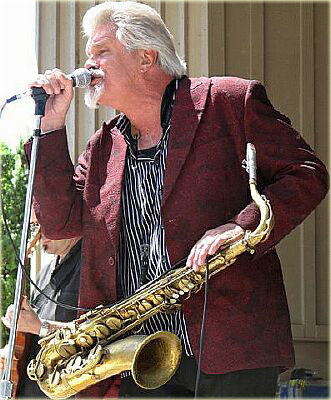
From Dorothy Hill's BLUESOURCE review of the 2007 Monterey Bay Blues Festival (June 23, 2007) "One of the more delightful presentations was the huge aggregation of musicians that went by the name of For The Love Of Ray. Although not very bluesy, they ignited the Main Stage with enthusiasm in a loving tribute to the music of Ray Charles. Outstanding vocal solos were delivered by Dino Vera on 'Georgia On My Mind' and Lee Durley on a jazz-inflected vocal take of 'You Don’t Know Me.' Gary Smith delivered an effective harmonica and vocal execution and ten-year-old Dhani James wowed the audience with 'Hit The Road Jack.' Terry Hanck joined the group on saxophone and vocals for a rousing version of 'My Time Is The Right Time.' Hanck then headed over to the Garden Stage for a set with guitarist Johnny Cat, Bob Welsh on keyboards and Butch Cousins on drums with me following. For those not familiar with Hanck, Tracy Nelson said it all in this quote: 'Terry Hanck is the funkiest, sexiest, most prolific and talented singer/songwriter/musician on the earth. He has to be Jr. Walker's bastard child.' " Full article here: http://www.bluessource.com/readarticles.php?id=27 |
 Terry at Monterey Bay Blues Festival |
BluesWax
BluesWax Sittin' In With Terry Hanck
Terry Hanck grew up in Chicago and dreamed of surfing California beaches. When he finally moved to California to ride out his dream, he took up the tenor sax. But it wasn't Surf music he wanted to play; it was the Blues and Soul music of Chicago that most caught his ear and landed him a job with Elvin Bishop that lasted more than 10 years."I played clarinet as a kid in fourth grade," says Hanck. "By seventh grade I forgot everything I'd learned. My father was a successful bandleader in Chicago, and he played all kinds of gigs and all kinds of music. I remember that I liked Dixieland music."
When Hanck was 11, Rock 'n' Roll ruled the airwaves. Those were the days in the mid-1950s when Cosimo Matassa was releasing the New Orleans R&B of Fats Domino, Lee Allen, and others. The first Rock 'n' Roll record Hanck bought was a Fats Domino 78 on Imperial: "I'm In Love Again," with "My Blue Heaven" on the flipside.
"Guys like Lee Allen and Huey 'Piano' Smith were playing the music that was just etched into my mind. Then, I didn't know that was New Orleans R&B. It was just music comin' outta the radio."
By 17, Hanck was going out to hear the Soul and Blues music Chicago offered. "I saw B.B. King at the Regal in 1962. I wasn't playing yet, so I didn't know who he was. I used to see Ray Charles there too, in 1963, when Ray was in his heyday. He did about 20 minutes before he broke into 'What'd I Say.' Then the Raylettes came strutting out and the place was going nuts. That did it for me. I was 17 or 18 then."
But there was also Hanck the diver and surfer. Without the endless surf of the West Coast, Hanck found a unique way to satisfy the beach boy in the Windy City, surfing on Lake Michigan. "Some of the best spots were around Northwestern University. I rode waves on a little reef I knew from diving. One day the waves were breaking on this reef into perfect little machine waves. There was never any doubt that I was gonna end up in California."
It was when Hanck moved permanently to Orange County in 1967 that his love of music returned. Hanck surfed all day and listened to radio all night. Specifically, he tuned into KBCA, a 24-hour AM Jazz station. That was when the sax spoke to him.
"I needed something for the nighttimes. So I figured, what's another career where I can't make any money? It was a natural to go from surf bum to sax player."
At first, Hanck was intrigued by the freedom of avant-garde playing. So he locked himself in a room and began honking and squawking without learning the basics. "I tried to go from A to Z without learning anything in between. I'd sit in a room and squawk like a dog with a rag in its mouth. Free form.
"After doing that for a couple of years, I got that outta my system and then I wasn't afraid to try things in my playing. I was so antisocial; I was looking for something that matched that. At that time, in the 1960s, music needed something like the avant-garde movement to blow everything open. There was a cultural explosion where walls had to be torn down. Nowadays, people have turned avant-garde into a style. It was meant to be an anti-style.
"Then I met some people who played Blues, and I started learning all over again, from the basics. I learned a lot from guitar and bass players. I started with the three-chord change. The first two keys I learned were E and A, and horn players hate E and A."
Hanck quickly rediscovered his love for Blues and Soul.
"I had the feeling and tone; I really didn't have the Blues theory. With me there's never been any division between Blues, Soul, and Jazz. The great horn players played the best Blues. If I'm gonna learn Blues licks, I'm gonna listen to Coleman Hawkins or Illinois Jacquet."
Hanck also reestablished his ties with earlier mentors like Lee Allen, King Curtis, and Hanck's personal favorite, Junior Walker."As far as Rock 'n' Roll, the guys who really stood out were King Curtis, Gene Barge, and Lee Allen. Junior Walker, to me, is in a class of his own. He wasn't playing Blues sax. He was playing Soul sax. His phrasing to me is the same as the way Albert King plays the guitar. He had the right tone. To me it was almost mystical. Not like Coltrane, but the same kind of feeling.
"Playing the horn helps me with my muscle control and breathing. It strengthened the diaphragm and throat muscles. I think being a vocalist helps me in the playing of the sax because the way I play I think more vocally. The sax is a real physical instrument. As a kid I was really into skin-diving and holding my breath. It's a release to kind of shout and get everything out. At the same time I'm screaming at everybody, I also have to control it so I can also whisper.
"The tenor is very close to the human voice. Playing the horn for a number of years has helped me in my singing. I didn't start out singing, but the horn opened up my throat. Now singing is as much a part of what I do as playing the horn."
In 1972 Hanck had a minor radio hit in the East Bay when the call came for him to join Elvin Bishop's band. Hanck didn't want to be part of a horn section, so he declined. Bishop persisted and asked again in 1976 after Hanck played on Strut My Stuff. Hanck again refused.
Finally, in 1977, "When he asked me the third time, I saw my record was going nowhere so I said yes. I went from driving around with my band in a potato chip truck to playing with Elvin for 10 years and riding in limousines and the best hotels. I went from playing in clubs with three people to playing at the Oakland Coliseum in front of 55,000 people screaming and loving it."In 2005, Hanck released Night Train. The CD was co-produced by Chris "Kid" Andersen, who also plays guitar throughout. Andersen, one of Norway's top guitarists, is currently touring with Charlie Musselwhite.
"About five years ago, I went to Norway and played at the Muddy Waters club in Oslo, and [Andersen] was part of the house band I used. He said he wanted to come to California to meet one of his guitar heroes, Junior Watson. I told him I was goin' back to cut a record and Junior was gonna play on that and you can come and meet him. Chris also played on that CD from 2003. He was with my band for about four years. He's one of a kind. They are really into that style from the West Coast, guys like Junior Watson or Hollywood Fats. I'm really lucky to have worked with some of the best guitarists."
Night Train includes covers of the timeless music Hanck has always loved. There are two Tommy Ridgley tunes, Sam Cooke's wonderful "Somebody Have Mercy," and Hank Ballard's "Have Mercy Baby." And there are six Hanck originals. On "Junior's Walk" Hanck offers a tribute to his idol, Junior Walker. Close your eyes and it's "Shotgun" all over."I write songs very stylistically. I might want an early 1950s feel or an early 1960s sound, so I want the rhythm on the guitar a certain way. When I write songs, I'm writing for an ensemble. I'm very demanding stylistically on the guitar players who work for me."
--Art TipaldiBlues Revue Magazine
Bay Area tenor saxophonist Terry Hanck, a veteran of Elvin Bishop’s band who has also worked with Etta James, Sista Monica, and Tracy Nelson, hits a high-water mark with his latest solo project. Backed by a stellar team that includes Robert Cray B-3 player Jim Pugh and Charlie Musselwhite guitarist “Kid” Andersen, as well as Sid Morris (piano) and Butch Cousins (drums), with occasional bass from Michael Brooks, Hanck lays down a sizzling collection of R&B and blues tunes marked by vocals and sax playing that are well-phrased, tuneful, and soulful.
On “Night Train” (not the Jimmy Forrest and James Brown staple), Hanck’s shouted lyric combines with a driving rhythm, a minor-key chorus, skittering guitar, and powerful sax to shape an impressive leadoff track that suggests the R&B tour to come. Stylistically, this train makes several well selected stops. New Orleans receives the longest layover, as Hanck turn in a rollicking reading of Fats Domino’s “Let the Four Winds Blow” (with two sax solos, a memorable guitar break from Andersen, and terrific work from Morris) and covers two Tommy Ridgley numbers, “Wish I Had Never” and the upbeat “Ooh Lawdy My Baby.”
The band finds a perfectly swinging tempo for “All Around the World,” which could represent Atlanta (home of its author, Titus Turner), Chicago (Little Milton hit with it on Checker), or Detroit (Little Willie John, whose “Big Blue Diamonds” receives a shimmering swamp-pop treatment here, also sang this one). The Motor City is also represented by a smoking take on Hank Ballard’s “Have Mercy Baby.” A version of Sam Cooke’s “Somebody Have Mercy” is marked by Pugh’s rolling organ, B.B. King-style guitar line from Andersen, Hanck’s passionate vocals, and a sax ride-out livened up by honks and upper register squeals.
Hanck’s originals are just as diverse. “Another Light” could pass for a Meters of Dr. John number, while “Smilin’ Through My Tears” suggests Ray Charles’ gospel-R&B fusion. Andersen outdoes himself here, with muted arpeggios for the rhythm and stining lead breaks, while Hanck’s sax tone is never lovelier. “Run Run Baby” tilts toward the sophisticated, swinging end of the blues spectrum – you can almost hear Joe Williams singing it in front of Basie’s orchestra. Fans of soul and blues will find Night Train an irresistible ride.
--Tom Hyslop
Juke Blues
TERRY HANCK A regular sight on the West Coast, Hanck spent many years as sax-man in Elvin Bishop's band, and was last mentioned in these pages back in 1998. His new one, 'I Keep On Holdin' On' is an album of the highest quality, accessible, and with major label production values. Jump-jive, R&B, rock 'n' roll and soul all rub shoulders on a CD full of energy. Hanck's voice is excellent, particularly on soul songs like the title track, his songwriting contains a rare pop sensitivity and the band is flawless. This deserves to be heard by a wider audience.
--Ian Mariss
See Magazine
Jump Around: Terry Hanck gets up and gets down in E-town for a second round
When Saxophonist, Vocalist, and Songwriter Terry Hanck first played Edmonton two summers ago at Edmonton's Blues Festival, he was unknown to most local fans. He became one of the most talked about performers that year, mostly in the "who is that guy; where does he come from, and why haven't I heard of him before" vein of conversation that inevitably follows the debut of a talented performer.
-Cam Hayden
Edmonton Journal
Terry Hanck boasts one of the tightest groups around:
Saxman's fans eagerly awaiting his return after nearly two years
Having American hornman Terry Hanck on the bandstand at Blues On Whyte is a breath of fresh air. The venue has been far too content in recycling the same 16 or 18 acts over the past three years, but that complaint can't be raised this week as this is only Hanck's second visit to our city as a frontman. This anticipated booking comes nearly two years after the tenor sax player and vocalist, whose talents were virtually unknown in this part of the world, wowed a crowd at the Labatt Blues Festival. Putting the same skilled group of musicians through their paces for the past three years is a bonus - for both Hanck and his audiences - as this quartet is one of the tightest units around, and not just on the club circuit.
With Hanck at the helm, patrons can discard any preconceived notions of watching a player light a smoke between tunes or witnessing members wonder aloud if they should play a shuffle or a ballad, while reminding a mate what key the piece is in. On Tuesday night, a large crowd tuned into this ensemble, which cast out polished, expertly arranged renditions of funk, R&B and soul tunes spun into perfectly paced hour-long sets. Hanck's horn of plenty leads the way as he and bassist Michael (Fly) Brooks, guitarist Chris (Kid) Andersen and drummer Butch Cousins snake their way through a classic '50s and '60s sound that draws on the inspiration of such departed greats as Junior Walker, King Curtis and Eddie (Cleanhead) Vinson. New Orleans-charged polyrhythmic attacks that give a nod to Professor Longhair or The Meters can give way at a moment's notice to a soulful vocal interpretation of a Chuck Willis gem from Hanck. Ditto for a bright and boastful arrangement of a T Bone Walker-style piece that puts Andersen, who is a show in his own right, in the driver's seat. Between sets, Hanck had an automatic response as to why he has been able to keep this particular unit together for three years when "bands are falling by the wayside in record numbers." "We've been able to get plugged into the country and state fair circuit back home and I can't tell you how important that is. We don't have to drive night after night from show to show. The working conditions are good. We might not be playing on the main stage at fairgrounds, but the production is always taken care of properly and we get to play three set a day. It just makes us tighter and tighter. Then when we show up for a festival date, we'll get up on the big stages and have been known to steal the show. We take a lot of people by surprise."
Hanck put in 10 years with the Elvin Bishop band between 1977 and '87, and it was there he and bassist Brooks first teamed up. Brooks had already been a member of the Bishop band for a few years, creating the pulse to tunes on such well-received albums as Let It Flow and the huge Bishop hit of '76, Fooled Around And Fell In Love. Brooks then joined the original Amos Garrett band in the early '80s and was a regular visitor to Edmonton between 1982 and '84, playing packed saloons like the Ambassador Blues Bar. With Brooks, Cousins is part of a rhythm section that lays everything down with authority while dissecting time signatures with great imagination and flair. Cousins comes from a musical family from the San Francisco bay area and his brother Richard is a longtime Robert Cray associate who co-wrote Smoking Gun. Hanck and company play through Saturday night at the popular Strathcona tavern. Fans can also take home the group's latest live disc, which is being sold off the bandstand. This is one R&B show that should not be missed.
--Peter North